Nestled amid the towering ridges of the northern Zagros mountains, where the pristine headwaters of Chehel Cheshmeh flow toward the fertile plains of Mukriyan, lies an ancient city whose name is interwoven with the secrets of the Mannaean, Scythian, and Median civilizations. Saqqez (Saghez) is not merely a geographic point on the map of western Iran; it is a living museum of continuous human habitation spanning more than three millennia and a strategic crossroads of civilizational history.
Where is Saqqez? Geographical Location and Topography
The city of Saqqez is situated in northwestern Iran in the northern part of Kurdistan Province, serving as the second most populous urban center in the province. Geographically positioned at latitude 36°14′ N and longitude 46°16′ E, Saqqez forms an essential bridge connecting Kurdistan with West Azerbaijan Province.
The county borders Bukan to the north, the mountainous border city of Baneh and the Kurdistan Region of Iraq to the west, Divandarreh to the east, and Marivan to the south. This geographical crossroads has historically positioned Saqqez as a vibrant commercial gateway between Mesopotamia and the Iranian Plateau.
1,496 meters
165,258
Alpine & Cold Semi-Arid
Cham Saqqez (Zarrineh River Basin)
The landscape is defined by two remarkable natural features: the iconic Mount Jaqel (2,730 m), known as the “Rooftop of Saqqez,” which serves as a natural bulwark and popular hiking destination, and the perennial Cham Saqqez River flowing through the heart of the city under ancient arched bridges.
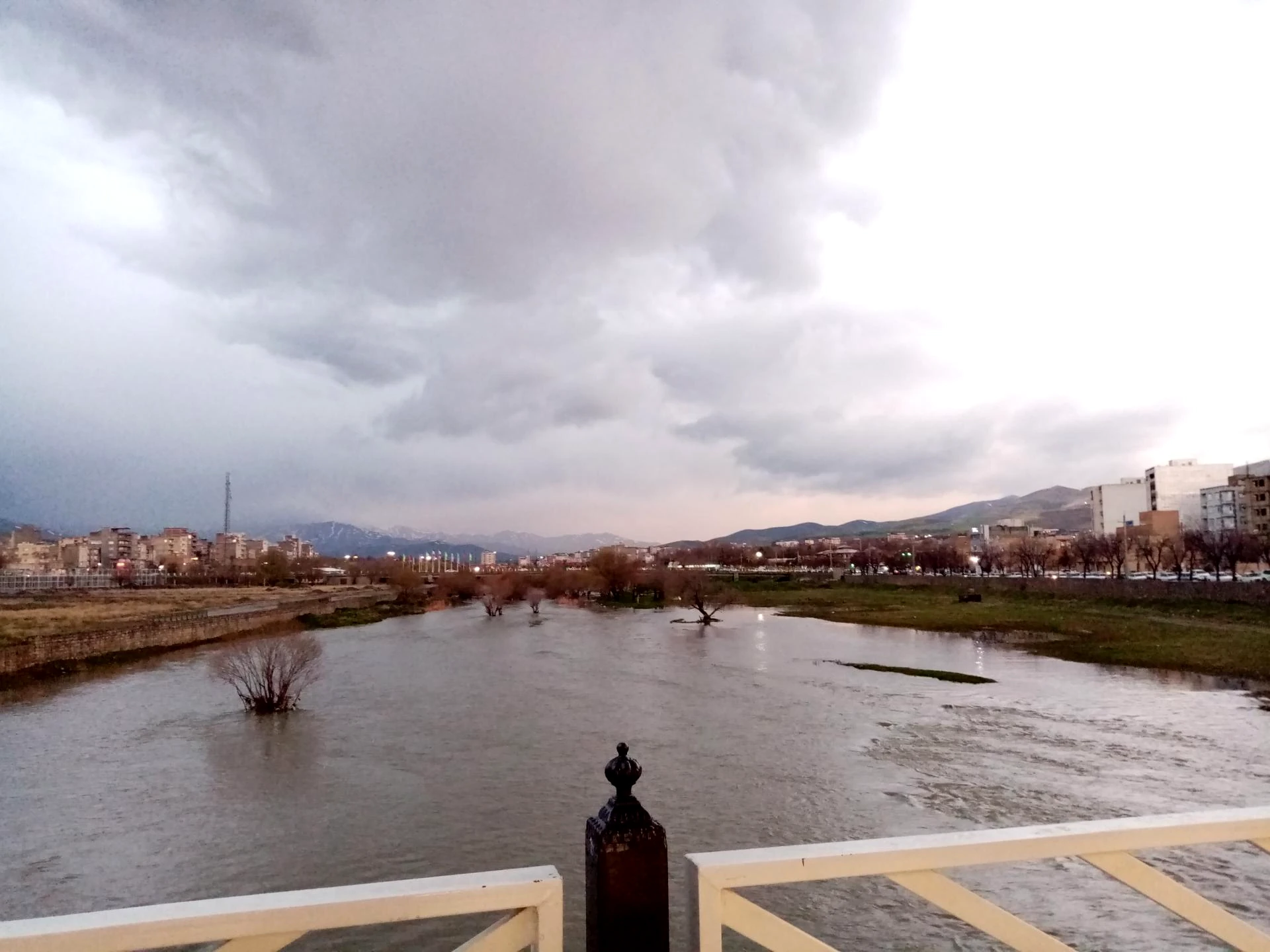
The permanent Cham Saqqez River divides and enlivens the historic urban landscape.
Etymology of Saqqez; The Scythian Hypothesis
The most widely accepted historical theory among scholars (including prominent historians Igor Diakonoff and Roman Ghirshman) traces the name Saqqez (Kurdish: Seqiz) to the Indo-European Scythians (Sakas). During the 7th century BCE (c. 650–625 BCE), equestrian Scythian tribes swept through the Caucasus into northwestern Iran, establishing a 28-year dominion over Mannaea and Media with their capital centered near Ziwiye and the Saqqez plain. The region came to be known as Sakiz or Sakavand (“abode of the Sakas”), evolving through phonetic changes into present-day Saqqez.
Antiquity; The Mannaean Citadel of Ziwiye and Karafto Cave
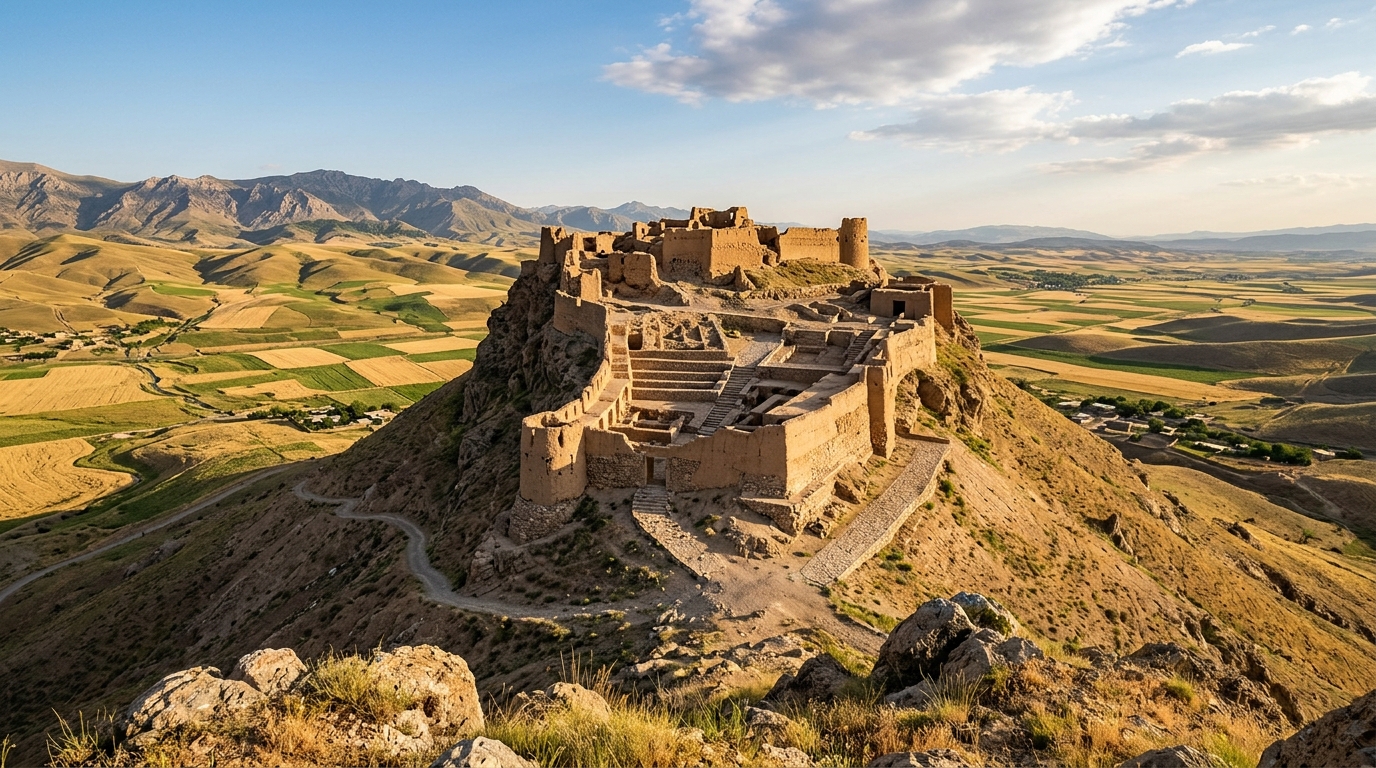
Located 42 km southeast of Saqqez, the 3,000-year-old Ziwiye Citadel stands upon a 100-meter hilltop as a supreme monument of Mannaean and Median architecture. The legendary “Ziwiye Treasure”—featuring gold plaques, carved ivories, and bronze artifacts blending Assyrian, Zagros, and Scythian artistic motifs—now graces the National Museum of Iran and the Musée du Louvre.
Nearby, the ancient rock-hewn Karafto Cave features a four-story troglodyte sanctuary bearing the famous Greek inscription: “Herakles dwells here; let no evil enter.”
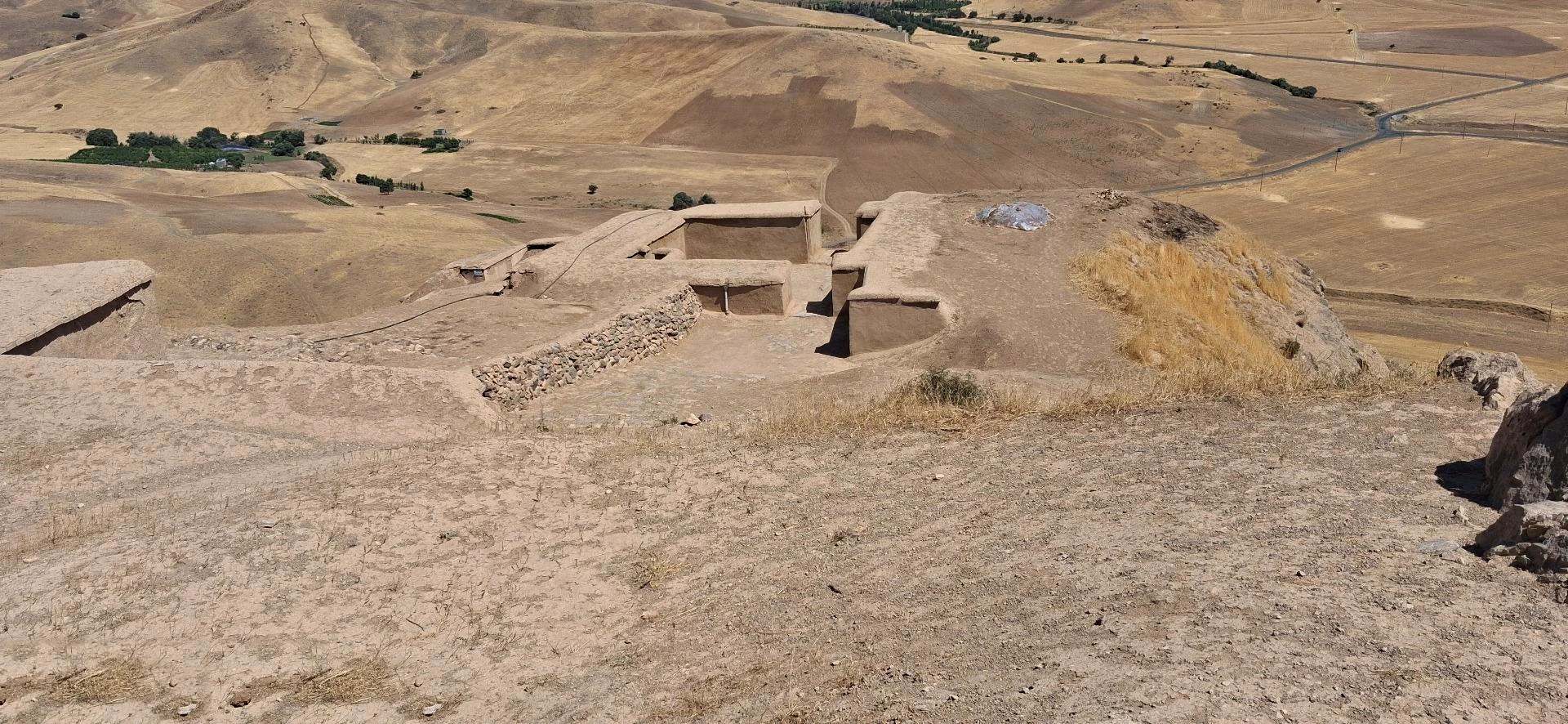
The 3,000-year-old mudbrick fortifications of Ziwiye Citadel, Saqqez.
Historic Urban Quarters and Cultural Legacy
The city’s historic fabric developed around the central Narin Qala (Citadel Hill) and features storied neighborhoods such as Nawe Qala, Sarpeche, Sharebani, and Dabbagh Khaneh. The Afsharid-era Two Minaret Mosque and Qajar-era Tajranchi Caravanserai reflect centuries of vibrant civic and mercantile heritage.
The inhabitants of Saqqez are predominantly Kurdish, speaking the melodious Mukriyani sub-dialect of Sorani Kurdish. For travel planning, explore our Comprehensive Saqqez Travel Guide and sociological study Life in Saqqez; Culture and Kurdish Traditions.